

This was first published on the Impact Newsletter
Eric Topol is an excellent example; he holds significant scientific prestige. The Scripps Institute, which he founded, aims to translate science into benefit. Not only do Topol and his institute publish papers, but they also lead innovation, seamlessly linking research and application.
People often confuse innovation with being innovative. Being innovative means doing something new.
Innovation is the act of creating something that improves others’ lives. So, innovators go beyond discovery and knowledge generation and drive towards practical implementation. Topol and the Scripps Institute are innovation leaders.
Innovation leadership
An innovation leader in science is someone who sees science through to the point that it provides benefits to others. They start with a vision of a better future and do what it takes to make it a reality.
Another impressive innovation leader is Michael J. Fox. Living with Parkinson’s, Fox envisioned detecting the disease before symptoms appear, enabling early intervention. While ambitious, his leadership has transformed the field of Parkinson’s disease. Fox commands significant scientific prestige.
We all cannot be as prominent innovation leaders as Topol and Fox. However, there is a way for you, no matter who you are, to become an innovation leader. Before we explore why innovation leadership matters and what innovation leaders do, let’s first explore why innovation leadership matters and what innovation leaders do.
Why innovation leadership matters
Innovation leaders in science don’t hand off their research results and hope others will use them.
Others don’t have the same vision driving them. They are more likely to give up on the research when the results don’t deliver right away. If a new target for a disease therapy and the first couple of trials fail, a company that has taken the reins from a researcher is likely to halt further development.
An innovation leader would ask why. Perhaps it was the wrong disease, or something else is needed to make targeting it effective. For example, only a subset of individuals with the disease may respond to a therapy targeting that target.
At the same time, innovation leaders have a deep understanding of the role of other disciplines. They understand that research and bringing a scientific result to the point where it is used require different skill sets. They don’t learn additional skill sets, but they do gain a degree of literacy in other disciplines to communicate with and work with them.
Innovation leaders make multi-disciplinary efforts possible.
Innovation leaders are persistent. There is a degree of faith that drives an innovation leader. It might then be argued that it is, in fact, better off to have someone else take the research findings forward. The innovation leader is biased. It could, however, also be that the faith in the vision is that her intuition, or subconscious, sees a pattern that is not easy to articulate without further research.
This was the case for Katalin Karikó. In 1990, she proposed mRNA as a therapeutic. The research community quickly soured on the idea; she failed to secure grants and was demoted. Yet she persisted. Developing mRNA therapeutics faced challenges, including inflammation. Karikó and immunologist Drew Weissman overcame this by altering the mRNA formulation. Her persistence paid off with the highest scientific honour: the Nobel Prize.
Most innovation requires changing complex systems, so new research findings are often constrained by prevailing paradigms and bottlenecks. Nevertheless, innovation leaders like Topol, Fox, and Karikó overcome these seemingly insurmountable barriers.
What do innovation leaders do differently?
Innovation leadership is not traditional authority-based leadership.
Harvard Business School Professor Linda Hill points out that leading innovation has become more about getting people to create with you. While you still need to have a vision, innovation leadership is also about shaping culture and capabilities so that you have a whole community of leaders working to create the future.
Hill describes three functions of innovation leaders: architects, bridgers, and catalysts. They build what is needed to move research into practical implementation. They work across disciplines, sectors and different types of stakeholders, and they promote the creativity and leadership of all of those around them.
Topol built the Scripps Research Institute, Fox founded the Michael J. Fox Foundation, and Karikó worked with many collaborators and served as a vice president at BioNTech.
The most important problems that any field faces usually have a wickedness to them. Wicked problems are problems with multiple interdependent factors and stakeholders that make simple solutions impossible. Think of world hunger as an example. There are also problems that require changing the prevailing system. Systems are themselves complex and adaptive and therefore resistant to change. The wickedness and systemic nature of important problems mean they are best addressed by building a system that influences and eventually replaces the existing one.
Building a system is a whole different level of leadership. The best systems are complex and self-organising. They are fertile ground for co-creation. They also require widespread awareness. Innovation leaders, therefore, communicate widely.
How to become an innovation leader.
Consortium projects foster innovation leadership. These projects unite leaders, and the best ensure that even junior members can step up and be creative. This inclusive structure unlocks nearly limitless possibilities.
I have come to think of consortium projects as the foundation for the complex system we need to build to achieve transformative change.
The multi-stakeholder and multidisciplinary nature of consortium projects makes them well-suited to advancing the process of building a system by turning a network into a community of practice.
When facing complex challenges that involve multiple disciplines and stakeholders, you not only need the collective intelligence of those disciplines and stakeholders, but also need to keep them motivated. The leader’s vision is not a good way to keep high agency people engaged. They need a degree of autonomy.
The key to innovation leadership is bridging daily routines and long-term impact, not simply crafting a vision. Ultimately, being an innovation leader requires a high degree of agency.
I recently asked Eleni Palpatzis, a neuroscientist studying cognition and ageing, and author of a newsletter on everyday brain function, about the relationship between goal setting, agency, and grit.
She is, by the way, an excellent example of an early-career researcher who demonstrates innovative leadership and skillfully communicates her science widely through her newsletter. Here is how she answered me.
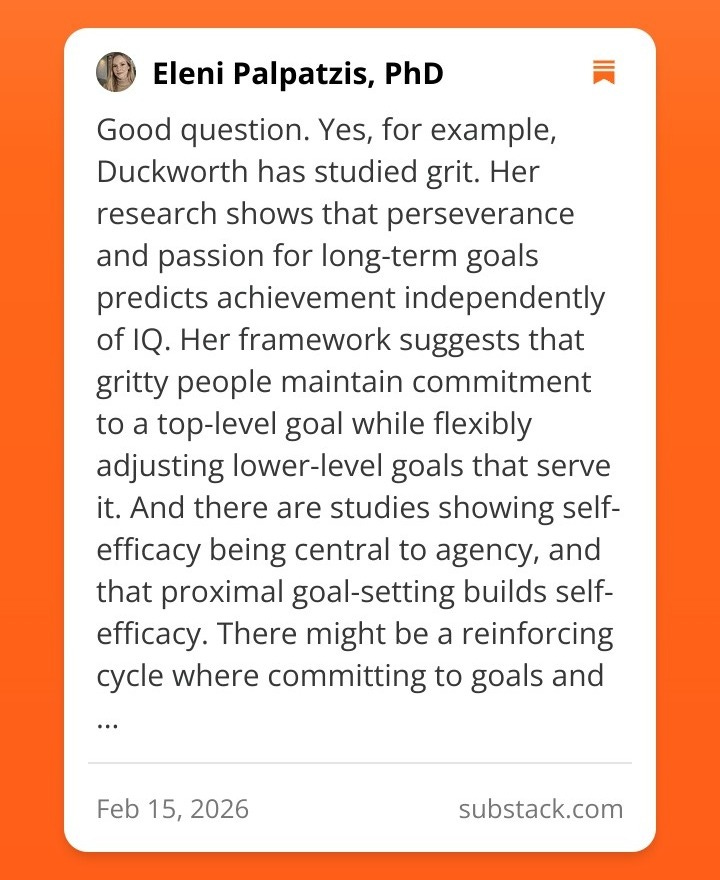
Her description of the role of short-term and long-term goals I think provides a basis for a practical path for developing as an innovation leader.
The plan
Set a long-term goal and vision.
Use that long-term goal to align with others who share it.
Set short-term goals together and build small projects, what I call tiny projects, that deliver in the short term.
Celebrate tiny project wins
Adapt those short-term goals based on the results of the tiny projects to build trust and momentum.
Apply for substantial funding using the achievement of your short-term goals as evidence for what is possible and your ability to work together.
This plan is for established scientists and all stakeholders in innovation.
If you are an early-career researcher, form a consortium with other early-career researchers.
If you are a biotech or med tech company, form a consortium with leaders in your field.
If you are part of a major pharmaceutical company, form a consortium with key opinion leaders and other companies.
If you are a patient, form a consortium with all the above, using your story and others like yours to bring everyone together.
If you decide you do want to become an innovation leader. There are many opportunities, and I would like to see if we can develop some of them for you. Reach out
Who is your favourite example of an innovation leader? Comment below.
References
Ground Truths by Eric Topol
Katalin Karikó National Inventors Hall of Fame
How the Leaders Drive Innovation Linda Hill HBR podcast